Alex scrambled out of his/her chair and approaches the girl. She was looking around nervously before Alex came closer.
This is the cognitive bias of the Halo Effect (“what is beautiful is good”). Unlike the ‘popular’ girl, this girl was on the quiet side and ‘seemed’ nice. Maybe the other guy should have been chosen to avoid this cognitive bias?
“Have you partnered up with someone?” Alex asked.
She smiles slightly and fiddles her fingers, “Uh, not yet actually.”
“Would you like to partner up?” She nodded and Alex took the empty seat next to her.
The teacher called for the class’ attention and gave a set of quick questions to ask the partner. It was easy to give out the answers; Alex and the girl, Emma were done in no time.
“So, lately there’s been an outbreak of measles. What do you think about it?” Emma asks out of the blue.
This is where System 2 takes over because the question is bigger than what System 1 can answer and requires more thinking.
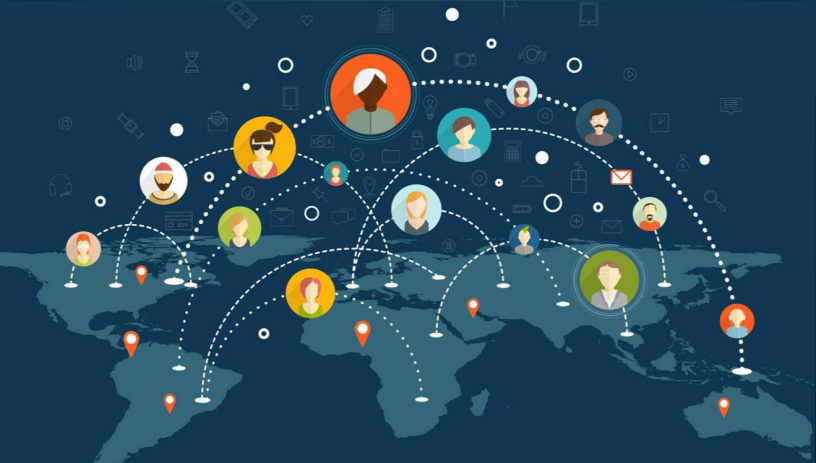
The growth of technology has continually allowed people to connect with others more than ever. There is the increase of use of telephones of the 2000s to social media platforms where everyone is capable of sharing about anything from stories to art. This is well beyond the days of Web 1.0, where only professionals could post. We have entered a new era of Web 2.0, where anyone is capable of connecting with others through the internet. Aside from the online exchange, you could physically go to another country. Through these experiences, there is an exchange of ideas, products, beliefs. This is globalization (Hermans, 2015).
Globalization gives us a perspective on the world. It’s counterpart, localization, refers to what has already been there since childhood. However, with the mixing of different cultures and lifestyles, there may be the development of an identity crisis. Globalization is Janus-faced, wherein it could be both a bringer of innovation but also marginalization (Hermans, 2015).
If we are careful to balance our local and global identities, it is possible to fuse these two identities into a hybrid form. This hybrid form is not necessarily the same as the original two, and instead may take a new form, an “alter ego”.
On the first day of February, the class was given time to share their global, local, and hybrid identity. This was in lieu of what we had learned regarding globalization.
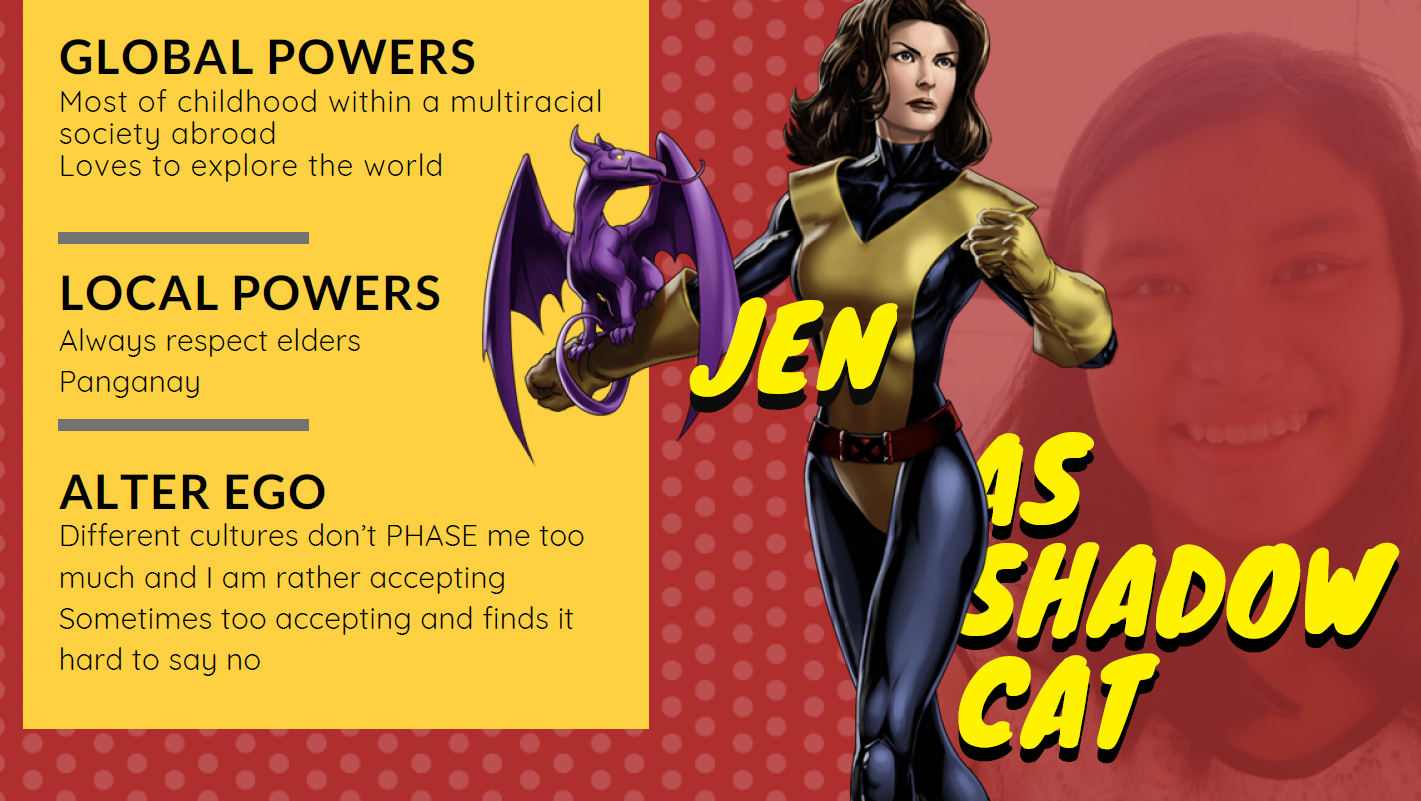
My group opted to use X-men as a metaphor for ourselves; each character has a unique set of powers. Global and local “powers” for many of us group members may intersect one way or another because of similar backgrounds.
For me, my global identity is someone who loves travel and exploration. On the other hand, my local identity lies in being respectful towards elders and being the “panganay” (first-born child). The panganay usually has the value of responsibility.
Shadow Cat is not a well known X-men member, but nonetheless is still doing her part. Her power is to phase through matter, and I used it as a pun in my presentation saying how differences don’t “phase” (faze) me and I am accepting and respectful of different beliefs, cultures and the like; particularly because I grew up Singapore. As from my presentation, I did say like globalization as a whole, it may be Janus-faced. I may be too accepting of differences that I forget what exactly is comfortable.
Globalization is something that we cannot stop against. For me, it great thing that can help the world progress forward. As an aspiring scientist, I believe globalization will aid greatly in the movement of science. Not only will the internet be able to share different researches, it is also a great medium to bring science to the common folk. But I am not denying that globalization has its own setbacks. There is the rise of racism and fake news online, poisoning international views. We should learn and teach others how to be careful so that the pros outweigh the cons.
Sources
Hermans, H. (2015). Human development in today’s globalizing world: Implications
for self and identity. In L. Jensen (Ed.), The Oxford Handbook of Human
Development and Culture: An Interdisciplinary Perspective (Ch. 3, pp. 28-42). New
York, NY: Oxford University Press.
What did I learn this week? About myself? About others?
How can I apply this learning in my life?
Entry #1
It was a pleasant day, cloudy but not raining. It made it easier to head to our first lesson on Social Science that 23rd of January. My Biology blockmates had decided to sit nearer to the front after learning slightly about the dynamics of the class, so we could listen and learn from the teacher better. The bell rang and the class opened up with a question:
What are the questions you have about the self?
Ma’am Therese Ocampo
We were instructed to write our question(s) on a piece of paper then paste our paper on the board. It took a moment before people started crowding around the board and I waited until most of the people were done. My question is as follows:
Why do we have existential crisis?
My question, slightly wrong grammar, but it gets the message across.
Those questions were asked so we could know if we’ll ever get them answered in SocSc. I liked how we could see how much we were connected in terms of our questions. There were many people questioning about their existence like “Who am I?” or even what exactly they are supposed to do? There were a handful of humorous ones like “Will I pass this semester?” and also rhetorical ones asking whether you exist for others or do others exist for you. Ma’am Ocampo went through each one of the questions, most of them being answerable later on in this class we were taking.
The lesson proper began with Urie Bronfenbrenner’s Theory regarding Systems Perspectives. He developed the Process-Person-Context-Time model over his lifetime. This concept is used to determine the correlations between different sets of environment and people and how they could affect an individual. Aside from the model, we also learned about the different ecological systems surrounding the “self”. Bronfenbrenner’s theory gives names to concepts we can understand but otherwise would have not thought about.
I enjoyed the activity the most out of the whole session. I knew my blockmates, but not the majority of my other classmates. It was intriguing to see our own take on what we ask about ourselves. From this, I have somewhat found a connection with other students despite being in completely different courses. Although I probably would not be blurting out “What is the meaning of life?” in everyday conversation, this class has allowed me to get some insight on what people may be worried about. In future interactions with my classmates, I hope that this activity will be a jumping point where we can make good connections.

 Jenica's Soc Sci Blog